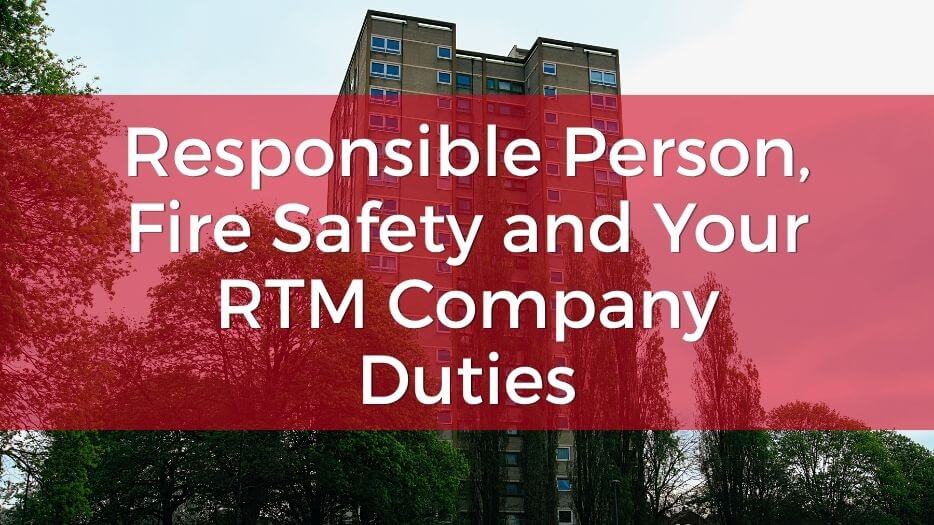
The right to manage (RTM) paperwork is signed. The freeholder's agent has handed over the keys to the fire panel cupboard. You and the other directors of the new right to manage company - all volunteers, all leaseholders yourselves - go back to your day jobs. Nobody mentions that, from that date, you or a co-director may be carrying a fire safety duty under the Regulatory Reform (Fire Safety) Order 2005. Responsible person fire safety is not a phrase in the RTM company's welcome pack. It describes a role that has very likely just landed on your desk, with no grace period to read up on it.
We've been a family-run Southend firm since 1979, and we know fire safety duties arrive with little warning. This article is for directors of a right to manage company running a residential block of flats in England. England, Scotland, Wales and Northern Ireland do not share the same rules here. Scotland and Northern Ireland have entirely separate fire safety legislation. Wales shares the Fire Safety Order with England, but not the England-only regulations covered below. Everything in this article is written for England.
In short, once a right to manage company takes over a block, it is very likely the responsible person who takes over the fire safety for the common parts. Under the Regulatory Reform (Fire Safety) Order 2005 (RRFSO, often shortened to "the Fire Safety Order"), the responsible person is broadly whoever has control of the premises in connection with managing it. For the common parts of a block of flats, the duty follows whoever is actually managing those parts. That is not necessarily whoever owns the freehold. The common parts are usually the hallways, stairwells, lobbies, plant rooms and shared external areas, but check your own building's guidelines, as this list may not cover everything.
When a right to manage company acquires the right to manage under the Commonhold and Leasehold Reform Act 2002, the landlord's management functions transfer to the RTM company on completion. Those functions are repairs, maintenance, insurance arrangement and day-to-day running of the building. In practice, this is widely understood to carry the responsible person role for the common parts across with it. Once the RTM company is the body actually managing and controlling those shared areas, it will typically take on responsible person duties for them.
If nobody flagged that at completion, that's not unusual. The transfer notice deals with management functions and service charges, not fire safety law. Nobody signs anything when the duty passes.
This is not a tidy, one-line legal rule. The Fire Safety Order does not mention RTM companies anywhere. Nothing in the published guidance gives a definitive, universal answer on how responsible person duties split between three parties. Those are an RTM company, a freeholder who has retained responsibility for elements of the structure and leaseholders inside their own flats.
The Order does not apply inside an individual leaseholder's own dwelling, behind their own front door. A leaseholder's private living space sits outside its reach, whatever happens with the common parts. For the structure, external walls and common parts, the RTM company stepping into the landlord's management functions is the trigger that, in most cases, brings the responsible person role with it.
There is an exception worth checking. If any element of the structure or external envelope was never transferred to the RTM company's remit, duties for that element may not have moved at all. A freeholder retaining direct responsibility for major structural repairs under the lease is one example.
A First-tier Tribunal decision concerning Globe View House, an 86-unit building in London, illustrates the point. The tribunal found that once the RTM company had taken on the repairing obligation for the common parts, the head leaseholder was no longer the accountable party under a related piece of legislation. That shows how the transfer is being interpreted in practice. But it is a first-instance tribunal ruling, not binding appellate law. Treat it as illustrative, not as a settled rule for every block.
Crucially, assume from day one of RTM completion that your company is very likely the responsible person for the common parts. Then get independent confirmation of where the boundaries sit for your specific lease and structure. This is a legal question. It is worth a conversation with a solicitor experienced in leasehold and right to manage law before you finalise who does what.
Getting this wrong carries real consequences. Article 32 of the Fire Safety Order makes it an offence to fail in the responsible person's duties where that failure places someone at risk of death or serious injury. On conviction in the Crown Court, the penalty can include an unlimited fine and up to two years' imprisonment, and a company can be prosecuted as well as individuals.
In November 2022, Portsmouth Crown Court sentenced a fire risk assessor and his company to a combined £100,040 in fines and costs. Their fire risk assessment at Forbes Court, a three-storey residential block in Hilsea, Portsmouth, was found to fall "far short of the appropriate standards". The Hampshire and Isle of Wight Fire and Rescue Service's area manager said, after sentencing, that the defendants "had no idea if Forbes Court was a safe place for those who lived there". It is a stark reminder of what an inadequate assessment can cost, and of why the person who appoints the assessor should check the work is competent.
The fire risk assessment is not the only Fire Safety Order duty that follows the role. Article 17 requires the responsible person to make sure the premises and the equipment provided for fire safety are subject to a suitable system of maintenance and kept in efficient working order. For the common parts, that means the fire detection and alarm systems, emergency lighting and firefighting equipment.
BS 5839-1 is the code of practice for fire detection and alarm systems in non-domestic premises, and it is the reference we work to for common-parts systems. BS 5266-1 plays the same role for emergency lighting on escape routes. Neither is itself a legal requirement. Both are recognised ways of evidencing that the Article 17 maintenance duty has been met.
This is the part of the duty we work on every day. We design, install and maintain fire alarm systems and emergency lighting. We are NSI Fire Gold certified since 2007 and BAFE registered for fire alarms (SP203-1) and emergency lighting (SP203-4). If we're not qualified to provide a service, we won't offer it. That is why fire risk assessments sit outside what we do.
Every responsible person has a duty, under Article 9 of the Fire Safety Order, to make a "suitable and sufficient assessment of the risks" to the people who use the building. That is the fire risk assessment. For a block of flats, the scope is wider than many directors expect.
Since the Fire Safety Act 2021 (in force in England from 16 May 2022), the Fire Safety Order's scope has been clarified - not newly created. In a building with two or more sets of domestic premises, the assessment must cover:
Flat entrance doors matter here because they are the barrier between a private dwelling and the escape route everyone else relies on. The Fire Safety (England) Regulations 2022 pick them up too, below.
A fire risk assessment for flats has to be a recorded assessment, in full. Section 156 of the Building Safety Act 2022 broadened this recording duty, in force 1 October 2023. Whoever carries out or assists with the assessment should be competent to do so. The law does not name a certification scheme, but certification is a recognised way to show competence.
On review frequency, the Fire Safety Order itself does not set a fixed interval. Article 9 requires the responsible person to review the assessment "regularly". It must also be reviewed whenever there is reason to think it's no longer valid, or there's been a significant change to the building or how it's used. A refurbishment, a change of use in a ground-floor unit, new cladding work or a near-miss are all examples.
Rather than invent a single number, the safest position is this. Review regularly. Review after any material change. Follow whatever interval the fire risk assessment itself recommends for your specific building.
The fire risk assessment should be carried out by a competent, independent fire risk assessor. Look for training, experience and (ideally) third-party certification that shows they can assess a residential block properly. That includes the structure, external walls and flat entrance door elements now explicitly within scope. When appointing an assessor, it is worth asking:
The written record is the document that matters most in practice. A thorough fire risk assessment will not just list findings. It will set out clear, prioritised actions with target dates. It will also specify what review interval it recommends, given the building's age, height and construction.
Many assessors structure that written record against BS 9792:2025, the British Standards Institution's published methodology for fire risk assessment of housing. It replaced the former PAS 79-2:2020 methodology. It is a recognised way of evidencing a thorough process, though following it is not itself a legal requirement.
Do not rely on a blanket industry rule of thumb for review dates. Evacuation strategy is a separate call. It is a decision for the competent assessor, made in the context of this specific building.
Fire doors in flats regulations in England come from one law. It is the Fire Safety (England) Regulations 2022 (SI 2022/547), which came into force on 23 January 2023. These Regulations apply in England only. They do not extend the same duties to Wales, even though Wales shares the underlying Fire Safety Order.
Regulation 10 sets specific, dated duties for buildings above 11 metres in height containing two or more sets of domestic premises:
Regulation 10's 11-metre threshold is separate from, and lower than, the 18-metre or seven-storey threshold. That higher threshold triggers a different set of duties under the same Regulations. They are a secure information box and up-to-date floor plans held by the fire and rescue service. They also cover monthly checks on firefighting lifts and equipment, and wayfinding signage.
Mix up the two thresholds and you'll either chase compliance work your block doesn't need or miss duties it does. Checking the height first avoids both. All multi-occupied residential buildings, regardless of height, must also give residents fire safety instructions and information about fire doors.
Nothing in the Regulations names a specific fire-door rating such as FD30. Nothing mandates a particular British Standard. BS 8214 is the code of practice covering fire door assemblies. It is a recognised way of specifying and evidencing a compliant door. It is not itself a legal requirement, and should always be described as a recommended means of meeting the duty rather than a mandate in its own right.
Communal fire doors - the doors onto stairwells, between corridors and into plant rooms - sit squarely with whoever is managing the common parts. For an RTM-managed block, that will usually be the RTM company. The Regulation 10 checking duty, and the cost of arranging and recording those checks, falls to the responsible person for those areas.
Flat entrance doors are more layered. The Fire Safety (England) Regulations 2022 put a checking duty on the responsible person. It is best-endeavours and annual, for buildings above 11 metres, as set out above. But who pays for repairing or replacing a flat's own front door, and who is contractually obliged to maintain it, is usually a lease question rather than a fire safety one.
Many leases make the leaseholder responsible for the upkeep of their own flat entrance door as part of their demise (the part of the building let to them under the lease). The landlord, or the RTM company once in that role, often retains a covenant (a binding promise written into the lease) over the frame or the door's fire-resistance where it affects the common parts. This varies lease to lease. Nothing here should be read as specific legal advice on any individual lease. If a dispute arises over who pays for a particular door, that's a question for the RTM company's solicitor or managing agent, read against the actual lease wording.
As a general mechanism, costs the RTM company itself incurs in meeting its fire safety duties are typically recoverable through the service charge, where the lease's repair and maintenance provisions cover it. Those costs include the fire risk assessment, door checks and any remedial alarm or emergency lighting work. Above a certain spend per leaseholder, formal consultation requirements can apply too. That is another reason to check the actual lease wording before assuming a cost will or won't pass through.
Once your checks find doors that need work, we can help. We're a division of Blake Contractors Ltd, which is BM TRADA Q-Mark certified for Fire Door installation and maintenance. We survey each door before we repair it. Our fire door surveys and repairs covered more than 250 communal and flat front doors across two blocks at The Maltings in Sawbridgeworth. Zone Property Management passed on the freeholder's verdict afterwards:
"The Freeholder mentioned that your company is fantastic, and he was really impressed with the service and knowledge of your team on site."
The Freeholder of The Maltings, Sawbridgeworth, as relayed by the Fire Safety & Compliance Officer at Zone Property Management
For the great majority of RTM-managed blocks, the responsible person duties under the Fire Safety Order are the main regime to deal with. For taller or larger buildings, a second, separate regime can apply alongside it.
The Building Safety Act 2022 defines a "higher-risk building" as one at least 18 metres in height or at least seven storeys, containing two or more residential units. For buildings meeting that threshold, the Act creates the role of "accountable person". This is a distinct role from the Fire Safety Order's responsible person. It is built around duties like registering the building with the Building Safety Regulator, maintaining a safety case report and engaging with residents.
Responsible person and accountable person are not competing labels for the same thing. They come from different legislation, and both can apply to the same building, held by the same organisation. For a qualifying building, the RTM company can be both the Fire Safety Order's responsible person and the Building Safety Act's accountable person. The accountable person duties sit on top of the existing fire risk assessment obligation, not instead of it.
The practical starting point is to check your own block's height and storey count against that 18-metre/seven-storey line. Below it, the accountable person regime does not apply, and you deal with the Fire Safety Order's responsible person duties. At or above it, a second layer of Building Safety Act duties applies as well.
A further layer applies to some blocks from 6 April 2026. That is when the Fire Safety (Residential Evacuation Plans) (England) Regulations 2025 (SI 2025/797) came into force. These Regulations apply to buildings with two or more sets of domestic premises that meet one of three tests. They are at least 18 metres in height, or have at least seven storeys, or are more than 11 metres in height and use a simultaneous evacuation strategy. The 18-metre and seven-storey limits match those for the accountable person regime. The 11-metre limb with a simultaneous evacuation strategy can catch lower blocks too, so check all three.
Where the Regulations do apply, the responsible person has a duty to identify residents whose ability to evacuate without assistance is affected by a physical or cognitive impairment. The responsible person must offer each of them a person-centred fire risk assessment (PCFRA). Where mitigating measures are reasonable and proportionate, the responsible person must seek to agree them with the resident. They must record the outcome in a written emergency evacuation statement and share a copy with that resident. This sits alongside the building's main fire risk assessment rather than replacing it. It is a further duty for the responsible person to track, not a different role.
Responsibility sits with whoever is the "responsible person" under the Fire Safety Order - broadly, whoever controls and manages the premises. For the common parts of an RTM-managed block, that will typically be the RTM company once it has taken over the landlord's management functions. Structural elements retained outside that management remit can sit with a different party. The Order does not apply inside an individual leaseholder's own flat. This is genuinely fact-specific. A legal check against the particular lease and management arrangement is worth having rather than assuming a single universal rule.
Yes. Article 9 of the Fire Safety Order requires the responsible person to carry out a suitable and sufficient fire risk assessment and to keep a full written record of it. Since the Fire Safety Act 2021 clarified the Order's scope (in force in England from 16 May 2022), that duty reaches further than many directors expect. It goes beyond the common parts into the building's structure, its external walls and every flat entrance door that opens onto a corridor or stairwell. Whoever carries out or assists with the assessment should be competent to do so, and certification is a recognised way to show it.
The Fire Safety Order itself does not set a fixed interval. Article 9 requires the responsible person to review the assessment "regularly", and whenever there's reason to think it's no longer valid or there's been a significant change. Examples are a refurbishment, a change of use, new cladding work or a near-miss. Rather than apply a generic rule of thumb, the safer approach is to follow whatever review interval the fire risk assessment itself recommends for your specific building, given its age, height and construction. Apply that alongside the "regularly and after material change" standard.
Communal fire doors are normally the responsible party's cost to maintain and check, commonly the RTM company's. That cost is recoverable through the service charge where the lease allows. Flat entrance doors are more often the leaseholder's own responsibility under the lease. The responsible person still has a checking duty for buildings above 11 metres. Exact liability always depends on the individual lease.
There's no blanket legal requirement that every existing flat entrance door be replaced to a specific fire rating. The Fire Safety (England) Regulations 2022 require best-endeavours annual checks of flat entrance doors in buildings above 11 metres. Guidance is explicit that older doors are not expected to meet current new-build standards simply because they lack certification or intumescent seals. Whether a specific door needs upgrading is a judgement for the fire risk assessment.
The Fire Safety Order requires the responsible person to provide "appropriate" fire-fighting equipment where the risk assessment identifies a need for it. It does not specify the type or number of extinguishers. Where extinguishers are provided, BS 5306-3 and BS 5306-8 are the recommended codes of practice. They cover selection, positioning, commissioning and maintenance, though neither is a legal requirement in itself. What's actually needed for a specific block is a question for the fire risk assessment.
Residential Personal Emergency Evacuation Plans (RPEEPs) are a duty introduced by the Fire Safety (Residential Evacuation Plans) (England) Regulations 2025, in force from 6 April 2026. They apply to buildings of two or more domestic premises that are at least 18 metres tall, or have at least seven storeys or are above 11 metres and use a simultaneous evacuation strategy. Where they apply, the responsible person must identify residents who may need help to evacuate and offer a person-centred fire risk assessment. They must also record agreed mitigating measures in a written emergency evacuation statement for that resident. Whether this applies to your block comes down to height, storey count and evacuation strategy. The 18 metre and seven storey limits match those for the Building Safety Act's accountable person regime, but the 11 metre limb with a simultaneous evacuation strategy can catch lower blocks too.
None of this is legal advice. A short blog post can't replace a proper review of your building's specific lease, structure and fire risk assessment. A solicitor experienced in RTM and leasehold law, alongside a competent, independent fire risk assessor, are the right people to confirm exactly where your RTM company's responsible person duties begin and end. We don't carry out fire risk assessments ourselves.
What we do is the work that follows when an assessment flags your fire alarm or emergency lighting. Our engineers put right the faults and gaps it identifies on those systems, and our fire door surveys and repairs cover the doors. Then our fire alarm maintenance keeps those systems tested and properly maintained. The aim is a block where every duty has a named owner, a written record and a review date.
If your fire risk assessment has raised questions about your alarm coverage or emergency lighting, call us on 01702 447800 or contact us online. The surveyor who visits your site introduces you to the engineer doing the work. We'll talk you through exactly what needs doing and when, with no obligation. A call is enough to start.